

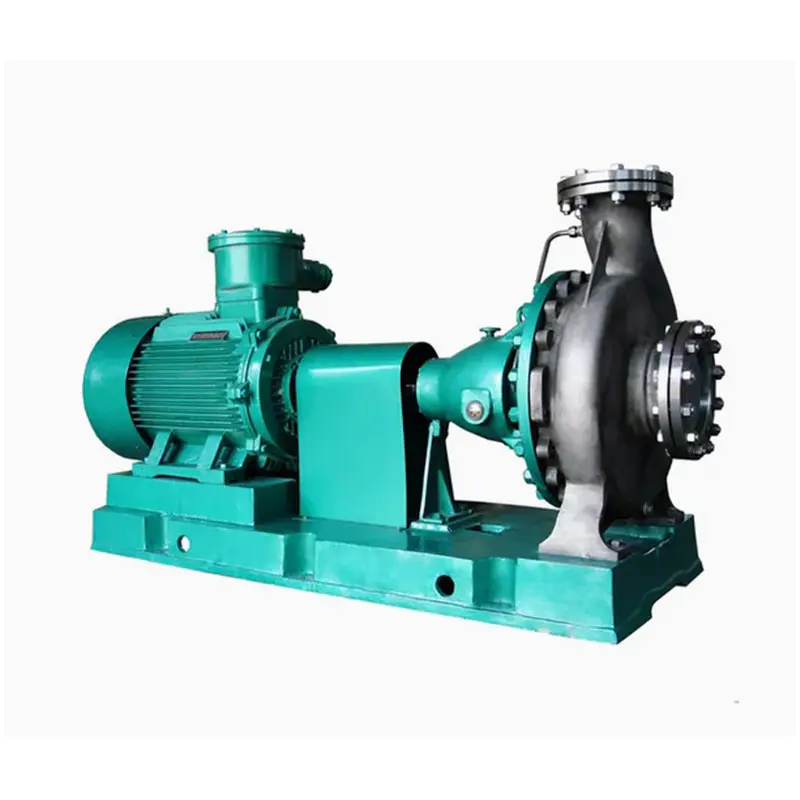
OH1 horisontal magnetisk drivpumpe
Cat:Magnetisk pumpe
Ytelsesområde: · Diameter: DN25 ~ DN400 · Strømningshastighet: opp til 2000 m³/t · Hode: opptil 250 m · Kraft: ...
Se detaljerSelecting pumps for industrial water systems is rarely a catalogue exercise. Two plants may both ask for “water duty,” yet one is moving clean cooling water at 60°C, while the other is handling settled process water with chlorides, sand, and a fluctuating discharge pressure. The pump that suits one may be a poor choice for the other. A practical selection process starts with the system, narrows the hydraulic duty, then checks materials, seals, and lifecycle cost.
Before comparing pump curves, get a proper water description. We look for pH, chloride level, conductivity, suspended solids, temperature, dissolved oxygen, and scaling tendency. It also helps to know where the water comes from and where it goes: raw water intake, cooling tower loop, process water, boiler feed, wash-down, or wastewater. Each has a different risk profile.
“Water” can be clean, corrosive, abrasive, hot, cold, viscous, or full of fibers. A pump selected for clear cooling water may suffer rapid wear in a stream carrying fine sand. A stainless steel casing is not automatically the right answer if chloride levels create pitting risk. In our experience, most selection errors begin with an incomplete fluid description. If the water chemistry is uncertain, ask for a sample and be honest about upset conditions. Our note on choosing materials for corrosive and abrasive duties explains why material selection deserves this early attention.
Flow should be the maximum sustained rate the system needs, not a comfortable average. Head is more than vertical lift. It includes static elevation, friction losses in pipes and fittings, pressure held at the discharge, and losses across control valves or heat exchangers. A pump curve means little until it is plotted against a system curve. If you cannot explain where the head comes from, the duty is not defined yet.
NPSH is the other half of the hydraulic story. Net positive suction head available must exceed the pump’s required NPSH with a usable margin, especially with hot water, long suction lines, or poorly arranged sumps. A pump that looks efficient on paper can still cavitate in service. Check minimum, normal, and maximum flow cases. A variable frequency drive may help, but it cannot fix a suction system that was never given enough margin.
End-suction centrifugal pumps are the familiar workhorses for clear water and many process water duties. Axial flow pumps suit high flow at low head, such as large circulation loops. Positive displacement pumps are better for viscous, shear-sensitive, or metered streams. Submersible and self-priming designs solve specific installation problems, but they are not interchangeable with a standard horizontal pump.
| Pump type | Typical water duty | Strength | Watch-out |
|---|---|---|---|
| End-suction centrifugal | Clear water, process water, cooling loops | Wide flow and head range, easy maintenance | Poor efficiency when oversized; seal arrangement matters |
| Axial flow | High-flow, low-head circulation | High capacity in a compact hydraulic path | Limited head; sump and approach design are critical |
| Screw or positive displacement | Viscous, shear-sensitive, or metered streams | Steady flow with good suction behavior | Needs pressure relief; not ideal for large clear-water transfer |
| Submersible | Sumps, wells, wastewater, wet pits | Saves space and avoids long suction lines | Cable and seal inspection; solids handling limits |
| Self-priming | Intermittent transfer with suction lift | Simple installation above the water level | Priming time, check valve maintenance, air leakage |
For large cooling-water or crystallization-loop circulation, axial flow can be a better fit than a small centrifugal unit pushed far beyond its comfortable range. Its flow capacity and performance flexibility make it useful where volume matters more than pressure, provided the sump and suction conditions are designed properly.
 Chemical Axial Flow Pumps for High-Volume DutiesFor large cooling-water or crystallization-loop circulation, this pump offers high flow in single- or multi-stage, vertical or horizontal styles with selectable corrosion- and wear-resistant materials.View Product →
Material selection should follow the water, not the other way around. Casing and impeller materials, wear rings, gaskets, and elastomers all need to survive the intended chemistry and temperature. A mechanical seal is often the first component to complain about a poor selection. Single seals may be fine for clean water, while double seals, quench arrangements, or external flush plans may be needed for dirty, hot, or crystallizing duties.
Standards also matter. API 610 is common in petroleum and petrochemical service, while ISO 5199 or ASME B73.1 style pumps are often used in chemical process plants. For general industrial water, over-specifying can add cost without adding reliability, but under-specifying a critical duty is worse. A standard chemical process pump with the correct impeller trim and seal arrangement can be a sensible starting point for clear or mildly aggressive process water.
 CZ Standard Chemical Process Pump for Chemical DutiesPositioned after guidance on API/ISO standards, this rear-opening process pump covers 1.6–1500 m³/h and is suited to clear or mildly aggressive chemical process water.View Product →
Hot water changes the selection more than many people expect. Vapor pressure rises, NPSH margin shrinks, and seal faces may need cooling or a different flush plan. Viscosity affects centrifugal pump performance, so a thicker stream may point toward positive displacement. Suspended solids bring abrasion, settling, and flushing concerns. In sumps and wet pits, the pump may also need to handle occasional debris without choking.
For hot water circulation, check the bearing arrangement, seal environment, and thermal expansion rather than relying only on the hydraulic curve. A pump built for hot water circulation will usually be more dependable than a standard cold-water unit adapted to the job.
 HPK Hot Water Circulation Pump for High-Temperature LoopsBuilt for hot-water circulation and heat-exchange media, this pump handles high temperatures and offers cast steel or stainless-steel construction with SKF rotor bearings.View Product →
Oversizing is one of the most expensive habits in pump selection. A pump that is too large often runs far to the left of its best efficiency point, with recirculation, vibration, seal distress, and wasted energy. A slightly larger pump is not a safety margin; it is a new operating problem. Select close to the real duty, then use impeller trim, speed control, or a smaller model where appropriate.
Lifecycle cost should include energy, seals, bearings, spares, and downtime. A cheaper pump that needs frequent seal changes may cost more over five years than a better-matched unit. Think about standby arrangements, isolation valves, suction strainers, and how maintenance staff will reach the pump. A good selection is one that can be maintained without drama.
Selecting pumps for industrial water systems becomes much simpler when the fluid, duty point, and operating range are written down clearly. The pump is only one part of the system, but it is the part that turns a good design into reliable operation. Take time to question the water data, the head calculation, and the real operating range. That discipline usually matters more than a glossy brochure.

Ytelsesområde: · Diameter: DN25 ~ DN400 · Strømningshastighet: opp til 2000 m³/t · Hode: opptil 250 m · Kraft: ...
Se detaljer
Ytelsesområde: · Diameter: DN25 ~ DN200 · Strømningshastighet: opptil 700 m³/t · Hode: opptil 1000 m · Temperat...
Se detaljer
Den nedsenkede pumpen er en utkraget vertikal design utviklet av vårt selskap, og kombinerer avanserte funksjoner fra både nasjonale og internasjon...
Se detaljer
Den smeltede saltet nedsenket pumpen er en spesialisert høye temperaturpumpe utviklet av Jiangsu Feixiang Pump Industry Co., Ltd. Denne produktseri...
Se detaljer
1. Ytelsesområde for CZ Type Chemical Pump (i henhold til designpunkt) Flyt: Q 1.6-1500m3/t Løft: H 5-125m Arbeidstrykk: P min...
Se detaljer
FB rustfritt stål kjemisk pumpe har fordelene med pålitelig ytelse, god tetning, vakkert utseende, enkel bruk og vedlikehold.
Se detaljer
FSB fluoroplastisk pumpeoversikt FSB-typen fluoroplastisk legeringspumpe er designet i henhold til internasjonale standarddimensjoner. Pumpe...
Se detaljer
IHF fluorforet kjemisk pumpe er preget av en rimelig og avansert struktur, sterk korrosjonsmotstand, tett og pålitelig mekanisk tetning, stabil dri...
Se detaljer
PWF korrosjonsbestandig avløpspumpe er en en-trinns, en enkelt-sucent, cantilever-type korrosjonsresistent sentrifugal avløpspumpe. Dets funksjonel...
Se detaljer
Oppslemmingspumper er spesialisert utstyr designet for transport av blandinger av væsker og faste partikler, ofte kjent som oppslemming. Disse pump...
Se detaljerCopyright © Jiangsu Feixiang Pump Manufacturing Co., Ltd. All rights reserved. Kjemiske pumper produsenter

 +86-18052670932
 +86-0523-84326888

 Nr. 35, Xinqiao Middle Road, Xinqiao Town, Jingjiang City, Jiangsu -provinsen, Kina